
Sound Recording
The sound track of a video is often the most important component. Weak or distorted sound, or a high level of unwanted background noise immediately marks the video out as unprofessional and viewers are unlikely to continue to the end. That is why Video Foundry takes particular care with sound recording.
A critical factor in recording good quality sound is to get the microphone close to the source. There are a number of ways to achieve this, and Video Foundry will choose the best method from the following:
Lavalier Microphones
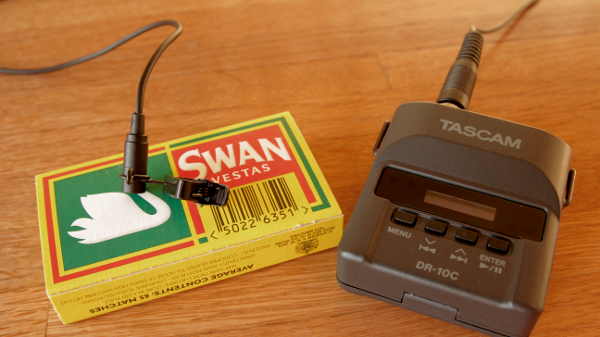
If it is acceptable for the microphone to be visible then this is a convenient and effective solution. The equipment used is shown below - the Sennheiser ME-2 microphone is powered and recorded with the TASCAM DR10-CS solid-state recorder. The later is a recently introduced device which offers important features and is built to exacting broadcast standards.
A solid state recorder such as this is a better option than a radio mic as it avoids drop-outs and interference, recording directly in 24-bit, 48 kHz digital WAV files. It records two files simultaneously, one at a lower level which can be used if clipping occurs on the higher level file. This gives exceptional dynamic range. Thus the recording level can be left fixed, and doesn't need to be set for each event. As you can see, it is exceptionally small, and can be slipped into a jacket pocket and will not be noticed.
Shotgun Microphone
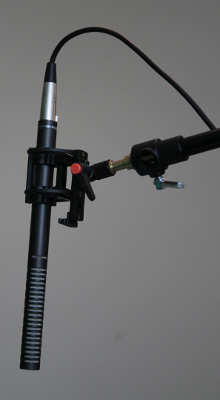
A lavalier microphone is omni-directional, which means it will pick up background noise in a noisy location. A shotgun microphone such as the Rode NTG-2 used by Video Foundry has a more directional response, and can also be shielded from wind noise by the wind shield shown below.
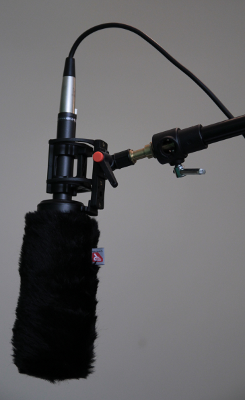
It is common practice that the boom used for the shotgun microphone is operated by an experienced boom operator. Video Foundry has a floor standing microphone boom which can support it in an optimal , fixed position, which is often all that is needed for interviews. This is an important way in which Video Foundry can reduce costs to you the end customer.

Lighting
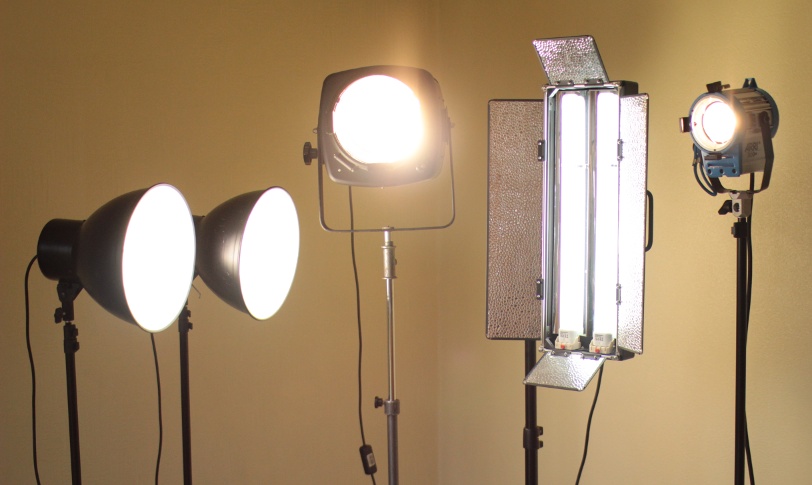
Filming with "available light" is a term applied to filming in which no special light sources are provided just for filming. This can produce excellent results, with a natural look and requiring minimal setup time and resources. But it has its limitations. Sometimes there is just not enough light to produce a satisfactory image even with the most of sensitive cameras. And it lacks flexibility. The positioning of your subject is dictated by the lighting conditions, and there may be no opportunity to create the lighting effects the production deserves. That is why Video Foundry has a range of both battery and mains powered lighting so as to be able to apply, where necessary, the industry standard, professional lighting techniques needed. Typically, this would involve three-point lighting of interview subjects, and creating the mood lighting so essential to achieve the filming objectives.
The following picture shows some of the mains powered lighting units. Of course, all these lights are covered by current PAT certification, details of which are included in the risk assessments prepared for each filming assignment.
Special Effects
Special effects does not always mean spaceships and meteorites! It can often means filming what can't be easily filmed with realistic costs. These case studies show special effects being used to overcome real problems on real customer projects.
Recovering a Flat Roof
While making a video about recovering a flat roof, it was realised that shots of the completed flat roof were marred by some cement splashes resulting from some re-pointing that they were doing on an adjoining roof at the same time. Costly reshooting was avoided by removing the splashes in post production, even in the shots which are panning across the roof, by motion tracking and replacing certain areas of the roof. Even though the technology is advanced, it is being used to address issues which arise in basic video production.
Cake Decoration
The client wanted a time lapse of the process of decorating a wedding cake, with the objective of demonstrating just how much work is involved in cake decoration, and to demonstrate the expertise required.
The cake decoration was filmed over a period of several hours at normal camera speed. Adobe After Effects was then used to speed it up selectively. If it was speeded-up by a uniform amount, then important steps in the cake decoration would have been compressed to only a few frames and the viewer would not have been able to see them properly, while other periods would have been repetitive and boring. The "Time Remap" feature was used to speed it up according to the content, achieving an overall compression from several hours to around six minutes.
An additional use of After Effects was to disguise the fact that for the filming, some of the upper layers of the cake were just polystyrene dummies. Using motion tracking and masking the polystyrene only was de-focused, so that it appeared to be more like the coating applied beneath the marzipan.
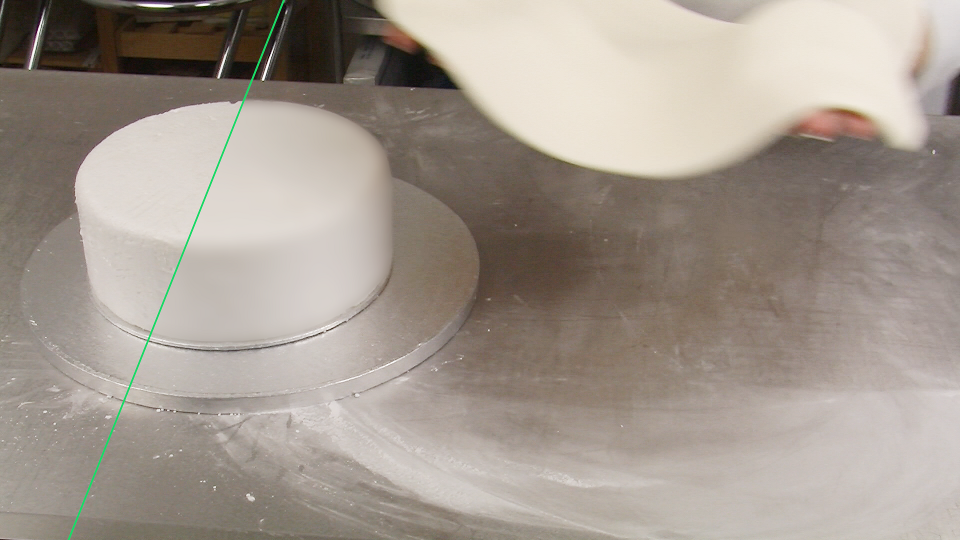
Here is the final video:
Multi-Camera Filming Capability
The use of multiple cameras to film an event or performance has benefits well beyond the obvious. Of course, one needs multiple views in a film, but by capturing multiple views during a single take of a performance, the task of editing is made significantly easier, because cutting between views will not lead to the likelihood of continuity errors that can result when cutting between shots captured at different times.
Video Foundry uses advanced software with two capabilities of direct relevance to multi-camera editing:
- Adobe Premiere-Pro for editing which has a multi-camera editing capability;
- Plural Eyes from Red Giant for synchronisation which ensures that multiple video tracks and audio tracks are correctly synchronised. This unique software tool achieves this by autocorrelation of the multiple audio streams, a mathematical technique which identifies when there is a peak of correspondence between the tracks when they are in a specific time relationship.
DVD Authoring
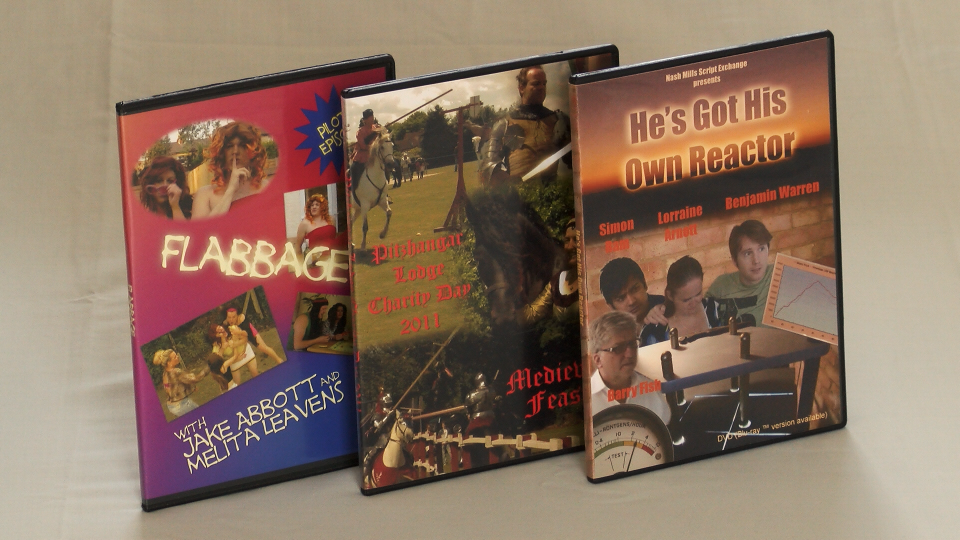
Video Foundry can create attractive media packaging such as the DVD cases shown here. We can incorporate the images you select from the video footage or supply separately, together with text and graphics. These elements will be composited to create a product which will grab the attention of the potential purchaser and viewer.
e-mail: info@videofoundry.net
or call 07305 983230
or call 07305 983230
